Getting started
Learn touch typing in 30 days
A realistic plan with 15 minutes a day, and why accuracy is faster than raw speed.
Automatically translated from German. Read the original
You won't learn to touch type in a weekend, but you will definitely get there sooner than in half a year. With a quarter of an hour a day, the home position and the most common letters are in place after about a month. What matters is not how long you practise, but how.
The home position first
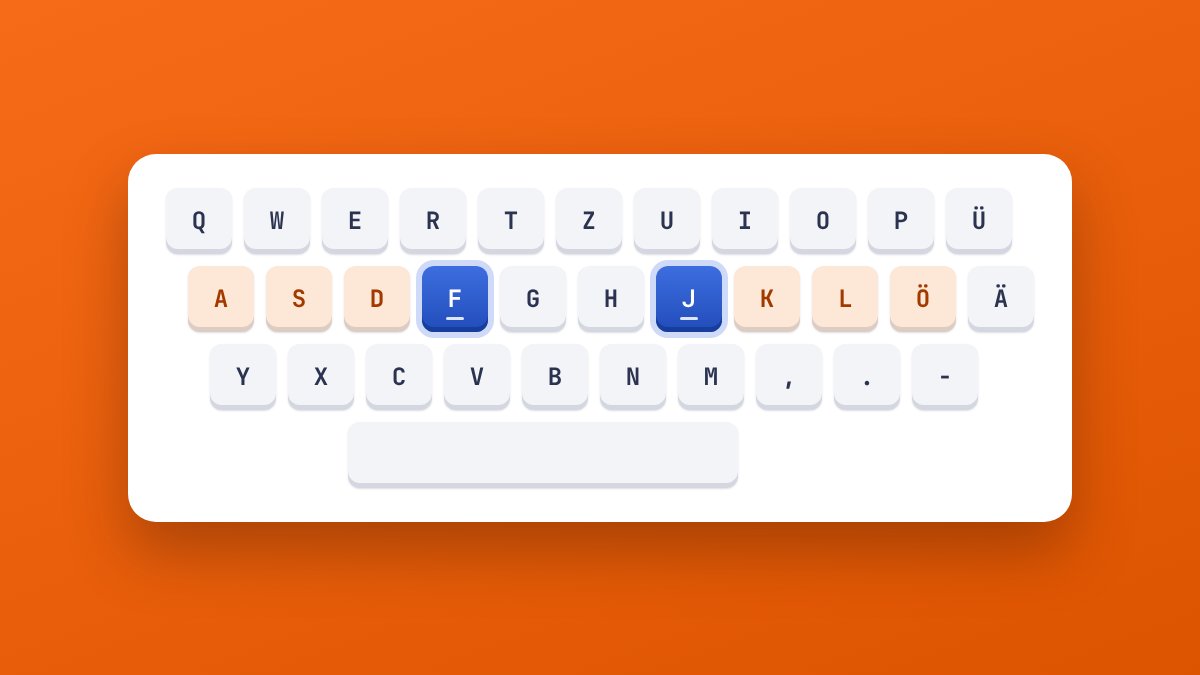
Your index fingers rest on F and J. You can feel the small bumps on these two keys without looking. The other fingers rest next to them on the middle row, your thumbs above the space bar. From there, every finger has its own keys, and it returns after every keystroke.
Don't look at the keyboard, even if it makes you slower at first.
At first this feels unfamiliar, especially if you have typed with two or four fingers for years. That's normal: the old movements are fast, the new ones not yet. After a few days, your habits start to change.
What a plan for the next four weeks could look like
| Week | Focus | Per day |
|---|---|---|
| 1 | Home position, which finger types which key, the most common letters | 15 minutes |
| 2 | More letters, first real words | 15 minutes |
| 3 | Capital letters and punctuation | 15 minutes |
| 4 | Whole sentences, slowly building up speed | 15 minutes |
Practising consistently for a quarter of an hour every day beats struggling through two hours once a week. Memory for movements settles between practice sessions. That's why many short rounds do more than one long one. Interestingly, most of the consolidation, and with it real progress, happens while you sleep!
Why accuracy comes before speed
Every mistake costs you three times: the wrong keystroke, the correction and the new attempt. On top of that, you practise the mistake every time it happens. If you deliberately type a little slower but accurately, you'll get faster in the long run. More on this in Accuracy before speed.
Keypacer is built around this: after a wrong key you stay on the same letter, and a new key is only added once the ones you have are accurate and quick.
Three rules for every day
- Short and regular: 15 minutes a day is enough. After that, concentration drops.
- Take a break instead of getting frustrated: when the mistakes pile up, stop and carry on later.
- Practise your weak spots on purpose: don't just copy texts, repeat the keys where you hesitate. Keypacer measures every keystroke and builds your next drill from it.
After 30 days you may not yet be faster than you were with two fingers. But you'll type without looking, and from then on it gets better every week.